What if you could run an organization with no CEO, no board of directors, and no office — just code and collective decision-making?
That’s not a thought experiment. It’s what a DAO (Decentralized Autonomous Organization) is — and thousands of them are operating right now, managing billions of dollars in assets across DeFi protocols, investment funds, and community projects.
But most explanations of DAOs are either too technical (written for Solidity developers) or too vague (“it’s like a company but on the blockchain”). This guide is neither. By the end, you’ll understand exactly what a DAO is, how it works under the hood, the different types that exist, and how you can create one yourself — even if you’ve never used crypto before.
Table of Contents
- What Does DAO Stand For?
- How Does a DAO Work?
- Key Features of a DAO
- Types of DAOs
- DAO vs Traditional Organization
- DAO vs LLC: Is a DAO a Company?
- Real-World DAO Examples
- Risks and Limitations
- How to Create Your Own DAO
- FAQ
What Does DAO Stand For?
DAO stands for Decentralized Autonomous Organization. Each word matters:
- Decentralized — No single person, company, or server controls the organization. Power is distributed across all members, and the rules live on a public blockchain that nobody can secretly alter.
- Autonomous — The organization runs on smart contracts — self-executing code on the blockchain. When a decision passes a vote, the result executes automatically. No employee needs to “approve” it, no manager needs to sign off.
- Organization — It’s still a group of people coordinating toward shared goals. The difference is how they coordinate: through token-based voting and transparent on-chain rules instead of corporate hierarchies and legal contracts.
The simplest analogy: a DAO is a company that runs on code instead of trust. In a traditional organization, you trust that the CFO won’t drain the bank account. In a DAO, the treasury is controlled by a smart contract — funds can only move when token holders vote to move them. The rules are public, the votes are transparent, and the execution is automatic.
As Ethereum.org defines it: a DAO is “a collectively-owned, blockchain-governed organization working towards a shared mission.” That definition captures the essence — collective ownership, blockchain governance, shared purpose.
How Does a DAO Work?
Understanding how a DAO works comes down to four components: governance tokens, smart contracts, the proposal lifecycle, and the treasury.
Governance Tokens = Your Voting Power
A DAO governance token is a digital asset that represents voting power within the organization. Think of it like shares in a company — but instead of entitling you to dividends, they entitle you to vote on how the organization operates.
The more tokens you hold (or have delegated to you), the more voting weight you carry. Most DAOs use the ERC20Votes standard on Ethereum, which records your token balance at the exact moment a proposal is created — preventing anyone from buying tokens right before a vote to manipulate the outcome.
Token holders can also delegate their voting power to someone else without giving up their tokens. This means you can let a trusted community member vote on your behalf if you don’t have time to evaluate every proposal.
Smart Contracts Enforce the Rules
Smart contracts are programs stored on the blockchain that execute automatically when predefined conditions are met. In a DAO, they enforce every rule:
- Who can create proposals (based on token threshold)
- How long voting lasts
- How many votes are needed for a proposal to pass (quorum)
- What happens after a vote passes (automatic execution after a time delay)
No CEO can override these rules. No board member can veto a passed proposal. The code is the arbiter — and it’s publicly visible on the blockchain for anyone to verify.
The Proposal Lifecycle
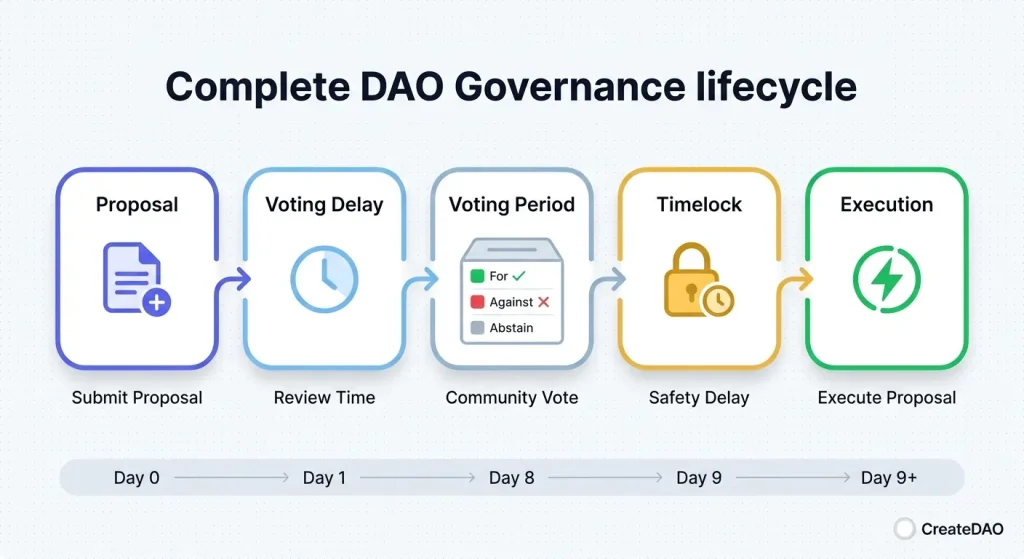
Every DAO decision follows the same transparent lifecycle:
- Proposal — A token holder with enough voting power submits a proposal. This could be anything: transfer funds from the treasury, change a governance parameter, upgrade a protocol contract, or add a new feature.
- Voting Delay — A short waiting period (typically 1 day) before voting opens. This gives everyone time to review the proposal and delegate their votes if needed.
- Voting Period — Token holders vote For, Against, or Abstain. The voting period typically lasts 1 week, though each DAO sets its own duration.
- Timelock — If the proposal passes (enough “For” votes + quorum met), it enters a mandatory waiting period before execution. This safety buffer — usually 1 day — gives the community time to detect and respond to any malicious proposals.
- Execution — After the timelock expires, anyone can trigger the execution. The smart contract carries out exactly what was proposed — no human interpretation, no selective enforcement.
The Treasury: A DAO’s Bank Account
A DAO treasury is a smart contract that holds the organization’s funds — governance tokens, ETH, stablecoins, or any other digital assets. Unlike a corporate bank account controlled by a CFO, the treasury can only be accessed through passed governance proposals.
This means no individual can drain the funds, redirect payments, or approve expenses without community consent. Every transaction from the treasury is publicly visible on the blockchain, creating complete financial transparency — something traditional organizations rarely achieve.
Key Features of a DAO
What makes DAOs fundamentally different from traditional organizations? Five properties that traditional companies can aspire to but can never fully guarantee:
- Transparent — Every vote, every proposal, every treasury transaction is recorded on a public blockchain. There are no closed-door meetings, no confidential board minutes. Anyone — member or not — can audit the entire history of every decision the organization has ever made.
- Trustless — You don’t need to trust the people running the organization because the rules are enforced by code. No single person can unilaterally change the treasury, override a vote, or rewrite the governance rules without going through the proposal process.
- Permissionless — Anyone holding governance tokens can participate in voting and proposal creation. There’s no application process, no membership committee, no geographic restriction. A token holder in Lagos has exactly the same governance rights as one in London.
- Global — DAOs operate on blockchains, which are inherently borderless. There’s no legal jurisdiction that can shut down a smart contract on Ethereum. Members can participate from any country, at any time, without needing permission from any authority.
- Immutable Rules — The smart contracts governing a DAO can’t be silently changed. Governance parameters can be updated — but only through the DAO’s own voting process. This means the rules of the game are stable and predictable, and any changes require community consensus.
Types of DAOs
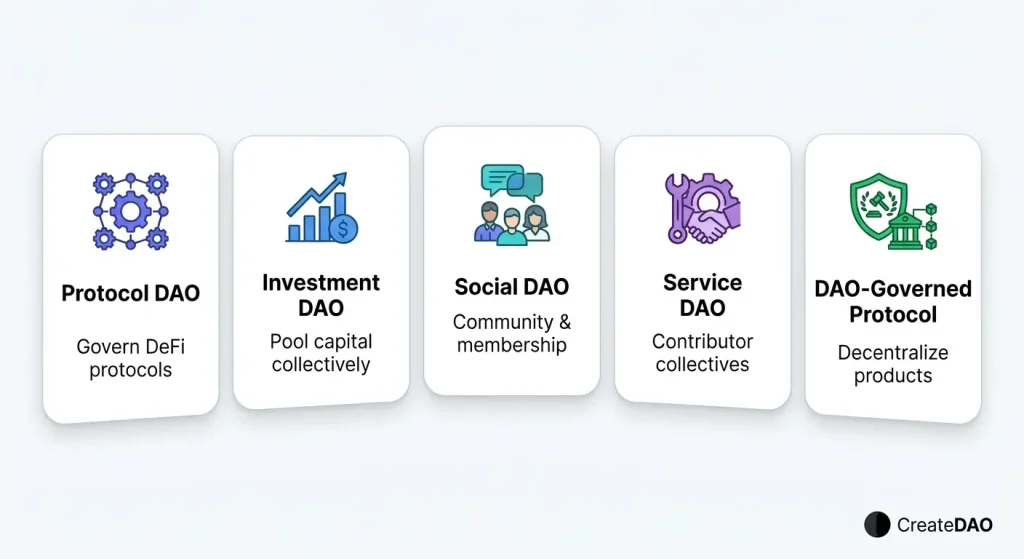
Not all DAOs are the same. The DAO structure is flexible enough to serve wildly different purposes — from managing billion-dollar DeFi protocols to funding community art projects. Here are the main categories:
Protocol DAOs
The most established type. Protocol DAOs govern decentralized finance (DeFi) protocols — the rules that control lending, trading, and stablecoin systems. Token holders vote on protocol upgrades, fee structures, treasury allocations, and risk parameters.
Examples: Uniswap (decentralized exchange), Compound (lending protocol), Aave (lending and borrowing), MakerDAO (stablecoin governance).
Investment DAOs
Investment DAOs pool capital from members and collectively decide where to invest. Think of them as decentralized venture capital funds — but instead of a few partners making investment decisions, all token holders vote on which projects to fund.
Examples: The LAO, MetaCartel Ventures, FlamingoDAO (focused on NFTs and digital assets).
Social DAOs
Social DAOs are community-focused organizations where membership and participation are governed by tokens. They’re used for creative collectives, social clubs, media organizations, and community funding. The token often serves as a membership pass rather than just a voting mechanism.
Examples: Friends With Benefits (FWB), Bankless DAO (media and education).
Service DAOs
Service DAOs coordinate groups of contributors who offer professional services — development, design, marketing, legal — to other projects. They operate like decentralized agencies or freelancer collectives, with governance controlling how work is sourced, priced, and revenue is distributed.
Examples: RaidGuild (Web3 development), LexDAO (legal services).
DAO-Governed Protocols
Some projects start as traditional companies and transition to DAO governance as they mature. The DAO controls protocol parameters, treasury spending, and strategic direction — but the protocol itself provides a specific service (escrow, payments, identity, etc.).
Example: Zenland — a decentralized escrow protocol on Ethereum whose governance is run entirely through a DAO deployed via CreateDAO. Fee adjustments, supported tokens, and protocol upgrades all require community votes.
| DAO Type | Purpose | Example |
|---|---|---|
| Protocol DAO | Govern DeFi protocols | Uniswap, Compound, Aave |
| Investment DAO | Pool capital, invest collectively | The LAO, MetaCartel |
| Social DAO | Community membership and funding | Friends With Benefits |
| Service DAO | Coordinate contributor collectives | RaidGuild, LexDAO |
| DAO-Governed Protocol | Decentralize existing products | Zenland (via CreateDAO) |
DAO vs Traditional Organization
How does a DAO actually compare to a traditional company or organization? The differences are structural, not cosmetic:
| Aspect | Traditional Company | DAO |
|---|---|---|
| Decision making | Board of directors / CEO | All token holders vote |
| Rules | Legal documents, bylaws | Smart contracts on blockchain |
| Treasury | Bank accounts (controlled by executives) | Smart contract (controlled by votes) |
| Transparency | Internal — selective disclosure | Fully public — everything on-chain |
| Jurisdiction | Country-specific incorporation | Global — borderless by default |
| Formation | Legal filing, lawyers, weeks | One transaction, minutes |
| Membership | Employment contracts, NDAs | Hold tokens — that’s it |
| Trust model | Trust executives to follow rules | Code enforces rules automatically |
| Audit | Annual, expensive, private | Real-time, free, public |
Neither structure is universally “better.” Traditional companies have clear legal standing, established regulatory frameworks, and familiar operational patterns. DAOs offer superior transparency, global accessibility, and resistance to corruption — but operate in a less mature legal environment.
Many organizations are finding a middle ground: using DAO governance for treasury and strategic decisions while maintaining a traditional legal entity for regulatory compliance. This hybrid approach gives you the transparency of on-chain governance with the legal protection of a registered entity.
DAO vs LLC: Is a DAO a Company?
One of the most common questions in the DAO space: is a DAO a legal entity? The short answer is: not by default, but it can be.
What a DAO LLC Is
A DAO LLC is a legal wrapper — a traditional LLC (Limited Liability Company) that recognizes smart contract governance as its operating agreement. Several U.S. states now allow this:
- Wyoming — First state to pass DAO LLC legislation (2021). Allows DAOs to register as LLCs with smart contract-based governance.
- Tennessee — Passed similar legislation recognizing decentralized governance structures.
- Marshall Islands — The first sovereign nation to recognize DAO LLCs, offering international options.
When You Need a Legal Wrapper
You might want a DAO LLC if your DAO needs to:
- Enter into real-world contracts (lease an office, hire contractors)
- Open a traditional bank account
- Provide liability protection for members
- Comply with securities or tax regulations
- Interface with government agencies or traditional businesses
When a Pure On-Chain DAO Is Sufficient
Many DAOs operate perfectly well without any legal wrapper:
- Protocol governance DAOs (governing DeFi protocols that exist entirely on-chain)
- Community DAOs that only manage digital assets
- Grant-giving DAOs distributing crypto funds
- Any DAO whose activities are purely on-chain
The Spectrum
Think of it as a spectrum rather than a binary choice:
| Structure | Governance | Legal Status | Best For |
|---|---|---|---|
| Pure on-chain DAO | 100% smart contracts | No legal entity | DeFi protocols, crypto-native communities |
| DAO LLC | Smart contracts + legal wrapper | Registered LLC | DAOs needing real-world interactions |
| Traditional company + DAO governance | Hybrid: board + token voting | Full legal entity | Existing companies decentralizing |
The good news: you don’t need to decide upfront. You can deploy a pure on-chain DAO today and add a legal wrapper later if your organization grows to need one. The smart contracts don’t change — you’re simply adding a legal layer on top.
Real-World DAO Examples
DAOs aren’t theoretical — they’re managing real money, governing real protocols, and making real decisions every day. Here are the most significant examples:
Uniswap DAO
Uniswap is the largest decentralized exchange on Ethereum, handling billions in trading volume. Its DAO — governed by the UNI token — controls protocol fees, treasury allocations (worth billions), and protocol upgrades. Every major change to how Uniswap operates goes through a governance proposal that UNI holders vote on.
MakerDAO
MakerDAO governs the DAI stablecoin — a cryptocurrency pegged to the US dollar. MKR token holders vote on critical financial parameters: which assets can be used as collateral, what interest rates to charge, and how to manage risk across billions in loans. It’s one of the most complex DAOs in production, effectively functioning as a decentralized central bank.
Compound
Compound is a lending protocol where users earn interest by supplying crypto assets. The COMP governance token gives holders control over the protocol — from adding new asset markets to adjusting interest rate models. Compound’s Governor contract was one of the first widely adopted on-chain governance frameworks and directly influenced the OpenZeppelin Governor standard used by CreateDAO.
Zenland — DAO-Governed Escrow Protocol
Zenland is a decentralized escrow protocol on Ethereum — and its governance runs entirely through a DAO deployed via CreateDAO. This means fee adjustments, supported token additions, and protocol upgrades all require community votes through the standard OpenZeppelin Governor system.
You can see Zenland’s governance in action on OpenBook, where real proposals are submitted, voted on, and executed — the exact same governance flow that any DAO deployed through CreateDAO uses.
This is significant because it’s not a testnet demo — it’s a production protocol managing real user funds, governed entirely by smart contracts that anyone can verify on-chain.
The DAO (2016) — A Cautionary Tale
No discussion of DAOs is complete without mentioning “The DAO” — the first major DAO, launched on Ethereum in 2016. It raised $150 million in ETH but was exploited through a smart contract vulnerability called a reentrancy attack. An attacker drained approximately $60 million before the Ethereum community intervened with a controversial hard fork to reverse the damage.
The lesson wasn’t that DAOs are broken — it’s that smart contract security matters enormously. The DAO used custom, unaudited code. Modern DAOs built on OpenZeppelin Governor benefit from years of security research, professional audits, and battle-testing across hundreds of production deployments. The reentrancy attack that brought down The DAO in 2016 would not work against today’s governance frameworks.
Additionally, modern DAOs include Timelock controllers — a mandatory delay between when a proposal passes and when it executes. This safety buffer didn’t exist in 2016. If it had, the community would have had time to detect and respond to the exploit before any funds moved.
Risks and Limitations
DAOs aren’t perfect. Understanding the risks helps you build better governance and set realistic expectations:
Voter Apathy
The most common problem in DAO governance. Most token holders don’t vote on most proposals — participation rates of 5-15% are typical even for major DAOs. This means a small minority of engaged members often makes decisions for the entire organization. Delegation helps (let active members vote on your behalf), but it’s an ongoing challenge.
Governance Attacks
If a single entity accumulates enough tokens (or borrows them via flash loans), they could theoretically pass malicious proposals. Defenses include: proposal thresholds (requiring significant token holdings to propose), quorum requirements (enough total participation), timelock delays (giving communities time to react), and snapshot-based voting weights (your balance at proposal creation time, preventing last-minute accumulation).
Smart Contract Risks
Smart contracts are code, and code can have bugs. While frameworks like OpenZeppelin Governor have been extensively audited, no software is 100% guaranteed bug-free. The mitigation: using battle-tested, open-source frameworks rather than custom code, and keeping timelocks active so the community can respond to any discovered vulnerabilities.
Legal Uncertainty
Regulatory frameworks for DAOs are still developing. Different jurisdictions have different (and often unclear) rules about whether DAO tokens are securities, whether DAO members have tax obligations, and whether DAOs have legal standing. Wyoming and the Marshall Islands have taken the lead, but most jurisdictions haven’t addressed DAOs explicitly.
Whale Domination
Token-weighted voting means wealthy participants have more power. A single holder with 30% of tokens has more voting weight than thousands of small holders combined. This mirrors traditional equity structures but can feel at odds with the “decentralized” ideal. Some DAOs experiment with quadratic voting or reputation-based systems to mitigate this, but token-weighted voting remains the standard.
How to Create Your Own DAO
If you’ve read this far, you’re probably wondering: how hard is it to actually create a DAO?
The answer in 2026: surprisingly simple. What used to require a Solidity developer, multiple transactions, and hundreds of dollars in deployment costs can now be done in three steps, no code, for free.
CreateDAO deploys a complete DAO — governance token, on-chain voting system (OpenZeppelin Governor), and treasury (Timelock Controller) — in one transaction. Everything described in this guide — proposals, voting, timelock, treasury — is what you get out of the box.
Here’s the quick version:
- Connect your wallet — Or sign in with Google via NYKNYC.app if you don’t have one (no seed phrase, no gas fees)
- Configure your DAO — Name, token details, governance parameters (sensible defaults provided)
- Deploy — One transaction. Three contracts. Your DAO is live.
The entire process takes less time than signing up for most SaaS products. And because CreateDAO uses the OpenZeppelin Governor standard, your DAO is instantly compatible with ecosystem tools like OpenBook for treasury management and governance tracking.
💡 Want to see this in action? Deploy a test DAO on Sepolia Testnet — it’s free, instant, and uses the exact same contracts as mainnet. No risk, full experience.
For the complete step-by-step walkthrough with screenshots and detailed parameter explanations, read our full guide: How to Create a DAO: The Complete No-Code Guide →
Frequently Asked Questions
What does DAO stand for?
DAO stands for Decentralized Autonomous Organization. It’s an organization governed by smart contracts on a blockchain rather than by executives or a board of directors. Decisions are made through token-holder voting, and the results execute automatically through code.
How does a DAO make money?
DAOs can generate revenue in several ways: protocol fees (e.g., Uniswap charges a small fee on every trade), investment returns (investment DAOs profit from portfolio gains), service fees (service DAOs charge for work performed), or grant funding from larger ecosystems. Not all DAOs are designed to make money — some exist purely for community coordination or governance.
Is a DAO legal?
DAOs exist in a legal gray area in most jurisdictions. Some states (Wyoming, Tennessee) and countries (Marshall Islands) have created specific legal frameworks for DAO LLCs. In most places, a pure on-chain DAO has no legal entity status — which means it can’t enter contracts or provide liability protection for members. You can add a legal wrapper (DAO LLC) if your use case requires it.
Can anyone create a DAO?
Yes. With tools like CreateDAO, you don’t need programming skills or deep crypto knowledge. You can deploy a complete DAO in minutes — and if you use NYKNYC.app (Google login), you don’t even need a crypto wallet or ETH for gas fees. The total cost is $0.
What is a DAO token?
A DAO governance token is a digital asset on the blockchain that represents voting power within the DAO. Holding tokens lets you vote on proposals and participate in governance decisions. Most DAO tokens follow the ERC20Votes standard, which records your balance at the time of each proposal to prevent vote manipulation.
What is a DAO treasury?
A DAO treasury is a smart contract that holds the organization’s funds. In CreateDAO deployments, this is the Timelock Controller — it holds 99% of all governance tokens at launch, and funds can only be moved through passed governance proposals. Every transaction is publicly visible on the blockchain.
How is a DAO different from a company?
The key differences: DAOs are governed by token holders (not a board), run on smart contracts (not legal documents), have fully transparent treasuries (not private bank accounts), and operate globally without jurisdiction constraints. DAOs form in minutes via one transaction; companies require legal filing, lawyers, and weeks of paperwork.
What is the most famous DAO?
Historically, “The DAO” (2016) is the most famous — it raised $150 million but was exploited due to a smart contract vulnerability, leading to the Ethereum hard fork. Among active DAOs, Uniswap DAO is likely the most prominent, governing the largest decentralized exchange with a treasury worth billions. MakerDAO is another major one, governing the DAI stablecoin system.
Conclusion
DAOs are not a futuristic concept — they’re live infrastructure in 2026, governing billions of dollars across DeFi protocols, investment funds, and community organizations. From Uniswap’s billion-dollar treasury to Zenland’s production escrow protocol, DAOs have proven they work at scale.
The technology has matured significantly since The DAO’s failure in 2016. Today’s DAOs are built on battle-tested frameworks like OpenZeppelin Governor, protected by timelock delays, and accessible to anyone — not just developers.
Whether you want to govern a DeFi protocol, manage community funds, coordinate a service collective, or decentralize an existing product — a DAO gives you transparent, trustless, and global governance out of the box.
And creating one has never been easier. No coding required. No platform fees. Just a decision to build something governed by its community rather than a few insiders.
🚀 Ready to launch your own DAO? Sign in with Google at NYKNYC.app, then deploy at CreateDAO.org. No wallet. No gas. Your DAO in minutes.
Create Your DAO on CreateDAO →
Related Articles:
- How to Create a DAO: The Complete No-Code Guide →
- How to Create a DAO Token: Governance Token Setup Guide →
- DAO Governance Explained: Proposals, Voting, and Treasury →
Last updated: April 2026